






Exhaustion, working while unwell, and concerns about disclosing mental health issues are putting employee wellbeing and business performance in focus in the Philippines, according to the TELUS Mental Health Index. More than half of workers, or 55 percent, say their mental health negatively affects their productivity at work.
The report from TELUS Health, a global digital health and workforce wellbeing company, found 48 percent of workers often end the workday mentally or physically exhausted, while 82 percent work while unwell at least one day a week. Seventy-seven percent would be concerned about limited career options if their workplace knew of a mental health issue. Together, the findings make employee mental health a strategic and commercial priority for employers, with implications for day-to-day performance and access to support.
Exhaustion and presenteeism bring a cost to business
Workers who often end the day mentally or physically exhausted record an estimated annual productivity loss of 49.5 working days, compared with 29.7 days among those who do not report exhaustion. These estimates include time off and reduced effectiveness while working, based on a standard 240-day working year. They represent lost productive time, rather than days of absence alone.
Presenteeism refers to reduced productivity while working unwell. Workers who never work while unwell record an estimated annual productivity loss of 17.3 days, compared with 64.1 to 71.1 days among those working unwell four or five days a week. For employers, this points to the importance of looking beyond attendance to understand whether employees are well enough to work effectively.
Financial pressures add to this strain. Half of workers identify personal finances as their main source of personal stress, and 54 percent lack emergency savings to cover basic needs. Those citing finances as their main stressor record an estimated annual productivity loss of 44.6 working days.
Workers without emergency savings recorded a mental health score of 55.5 out of 100, compared with 69.0 among those with savings and an overall score of 61.6. Higher scores indicate better mental health.
“For many workers in the Philippines, daily financial survival and family obligations leave little room for long-term safety nets,” says Paula Allen, Global Leader of Research and Insights, TELUS Health. “When 54 percent of employees lack basic emergency savings, any unforeseen expense such as a health emergency, family needs, or disaster-related work stoppages can turn into a mental health crisis. The ongoing anxiety this creates, directly reduces workforce productivity. Employee financial wellbeing, especially savings, is deeply interconnected with workplace mental health across the Philippine labor market.”
The report also identified pressures affecting younger workers and the wider workforce:
-
Younger workers: Those under 40 were twice as likely as workers over 50 to report constant stress and to cite mental health as their main personal stressor. They were also 70 percent more likely to end the workday feeling mentally or physically exhausted.
-
Natural disasters: Twenty-four percent reported losing income because of work stoppages, while 14 percent had difficulty working remotely because of power outages or internet disruptions during natural disasters.
-
Workplace pressures: High workload was the leading source of work stress for 21 percent of workers, followed by lack of work-life balance at 20 percent and insufficient resources or support at 13 percent.
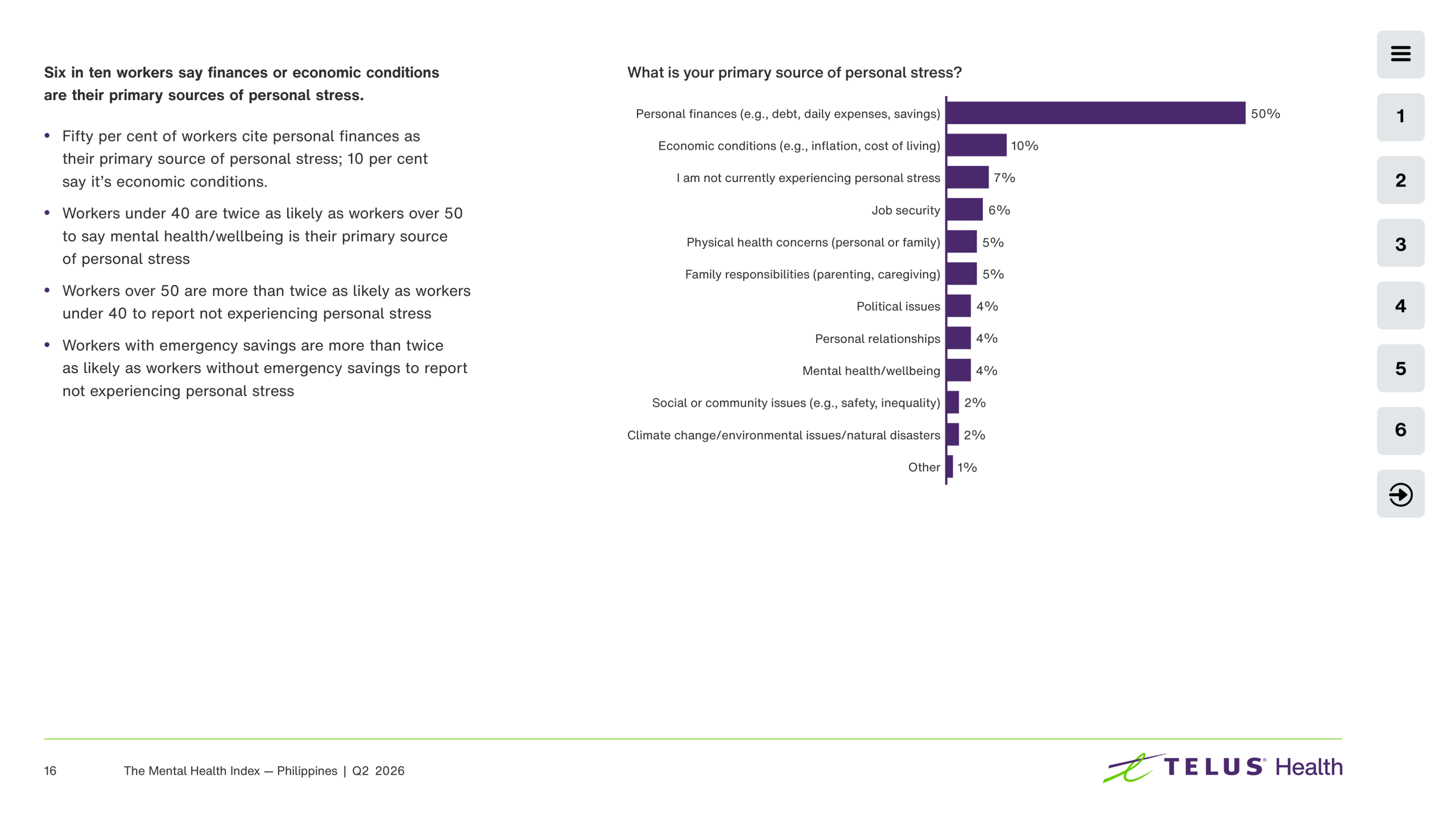
Personal finances are the leading source of personal stress for half of Philippine workers surveyed in the TELUS Mental Health Index. (Source: TELUS Health, Philippines Mental Health Index, page 16.)
Stigma and gaps in support strengthen the case for employer action
Seventy-seven percent of workers said they would be concerned about limited career options if they had a mental health issue and their workplace knew about it.
The report’s detailed stigma findings also showed 63 percent would feel negatively about themselves if they had a mental health issue, up from 57 percent in 2022. For employers, these concerns underline why access to a service alone is insufficient. Employees also need confidence in its confidentiality and in how their workplace responds when they seek help.
“Workplace culture and cultural stigma are barriers to workforce wellbeing in the Philippines,” said Jamie MacLennan, Region Head, Asia-Pacific, TELUS Health. “More than three-quarters of employees fear their career progression will be impacted by disclosing mental health challenges and this silent suffering is costing companies in lost productivity. People leaders don’t feel equipped to handle wellbeing conversations, so leaders have an urgent responsibility to support managers with proper training to address workplace stigma and ensure accessible, judgment-free support systems for every employee.”
Cost was the most commonly reported barrier to mental health support, cited by 52 percent of workers. Thirty-two percent did not know which type of care was best for them, while 29 percent did not know where to seek help.
Gaps in workplace support were also evident. Only 60 percent of managers said they would know what to do if they suspected an employee was struggling with a mental health issue. Separately, 42 percent of workers said their manager had not communicated the availability of health and wellbeing programs.
The findings strengthen the case for treating Employee Assistance Programs (EAPs) as part of workforce and business planning. Employers should make confidential support easy to access, explain the services available and how employee information is handled, and equip managers through facilitated training to discuss mental health and direct employees to mental health and wellbeing programs. This support should sit alongside action on workload, work-life balance, and access to resources. The business priority is to address the pressures affecting employees and help them seek support before those pressures further disrupt their work.